
5 Brainstorming Lenses That Surface Opportunities Others Miss
You’ve been in this meeting.
A big technology shift lands in your industry. Someone forwards an article. There’s pressure from the board. So someone books a brainstorm. Smart, experienced people fill the room. Somebody writes “How do we use this?” on the whiteboard.
Two hours later, you’ve got a list of feature ideas. A couple are interesting. Most are incremental tweaks to what already exists. The meeting ends.
Here’s the thing. The question did exactly what questions do. “How do we use this?” opens one door. The problem isn’t the people in that room. It’s that one door only leads to one kind of opportunity.
The teams that consistently find the whitespace others miss aren’t smarter or better funded. They ask different questions. Five, not one. Each one opens a different door.
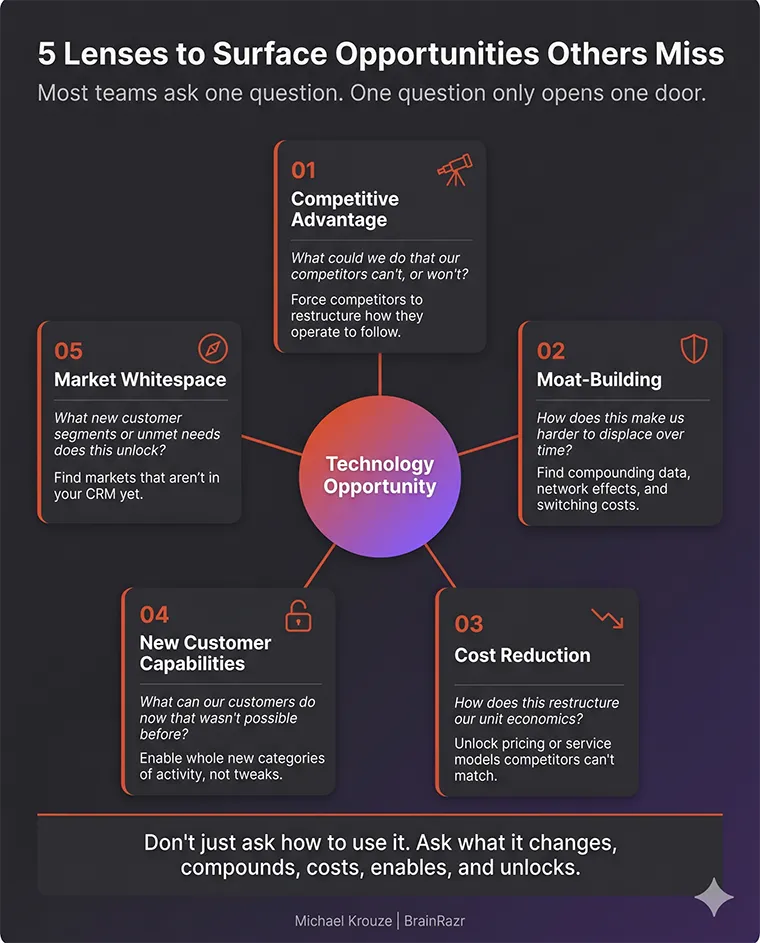
Lens 1: Competitive Advantage
What could we do that our competitors can’t, or won’t?
Most brainstorms start with inward questions. What could we build? How would it work? What would it take? Useful questions, but they all point the same direction.
This lens turns the question outward. Not “how do we use this?” but “how does this change the competitive landscape, and where does our position give us an edge nobody else has?”
Look at what Airbnb was actually doing in the early 2010s with mobile-first design and geolocation. On the surface, they were building a booking platform. The more interesting question is why the hotel industry couldn’t do the same thing quickly. The answer wasn’t the technology. It was the combination of deployment speed and a business model hotels weren’t set up to run.
So the question isn’t “can we build this?” It’s “can we build this in a way that would force our competitors to restructure how they operate just to follow?” If the honest answer is no, the opportunity is real, but it’s going to commoditize fast. Speed matters, not differentiation. If the answer is yes, you’ve got a wedge.
Here’s a follow-on worth asking. Where does your existing position create an edge? The same technology running on top of a proprietary dataset, a unique distribution channel, or a customer relationship you spent a decade building produces a completely different outcome than the same technology deployed from scratch.
Lens 2: Moat-Building
How does this make us harder to displace over time?
Competitive advantage is the short game. Moat-building is the long game. The question isn’t what the technology does right now. It’s whether it helps you get more entrenched the longer you use it.
The cleanest modern example is recommendation systems. Netflix’s early investment in personalization wasn’t just a better feature. Every viewer interaction made the model better. A better model made the experience stickier. A stickier experience produced more data. More data improved the model again. The moat deepened with usage. Competitors couldn’t replicate it by copying the feature. They’d have to replicate years of behavioral data at scale.
That’s a fundamentally different kind of asset than a software feature. It compounds.
This lens helps most when you’re evaluating data, network effects, and switching costs. Does adoption produce proprietary data that compounds? Does it create integration dependencies that raise the cost of leaving? Does it enable feedback loops that get better automatically with scale?
Miss this lens and you end up with investments that generate short-term value but no durable advantage. The feature ships. Competitors copy it inside 18 months. The differentiation is gone. You might still be making the right call. But if you can’t answer “how does this compound?” you’re buying efficiency, not durability.
Lens 3: Cost Reduction
How does this reduce the cost structure of what we already do?
This one gets undervalued, especially in product organizations that treat innovation and new features as the same thing. They’re not. Technology-driven cost reduction can restructure unit economics in ways that open up entirely new market strategies.
The question isn’t just “how does this reduce our costs?” It’s “how does cost reduction change what we’re able to offer at a price point our competitors can’t match?”
Walmart spent decades investing in supply chain and logistics technology. It didn’t just cut costs. It created a structural cost advantage that let them operate on margins competitors couldn’t touch. The cost reduction was the market strategy.
For teams looking at emerging technologies, the useful questions are these. Where in your current operations is cost a strategic constraint and not just a line item? Which cost reductions, if you got them, would unlock pricing or service models that aren’t viable today?
And here’s the question that usually surfaces the real opportunity. What would you do differently if a key cost dropped by 50%? That one forces teams past the reduction itself and into the strategic implications downstream. That’s usually where the interesting bets live.
Lens 4: New Customer Capabilities
What can our customers do now that wasn’t possible before?
This is where the shift from product thinking to platform thinking happens. And I think it’s where the largest category of opportunity lives, and where most teams have the most room to grow.
The default question in a product brainstorm is “what feature should we add?” This lens replaces it with something more fundamental. What new jobs can our customers now do? Jobs they either couldn’t do at all, or couldn’t do without serious friction, time, or expertise.
Stripe is worth studying here. When they launched in 2011, the obvious product was an easy payments API. The more interesting thing Stripe enabled was this. A developer could launch a transactional business in hours instead of months. Stripe didn’t just improve payment processing. They enabled a whole category of businesses that couldn’t exist before because the infrastructure barrier was too high. Shopify did the same thing for e-commerce. Neither company got where they are by making existing tasks a little easier. They got there by collapsing the barriers to entirely new categories of customer activity.
Apply this lens by asking what your customers currently can’t do, or can’t do at scale, that this technology makes possible. What expertise does the technology substitute for, so customers who didn’t have that expertise can now participate? What new markets open up when customer capabilities expand?
This lens also tends to surface partnership opportunities. If a technology enables a new customer capability but requires adjacent products or services to deliver the full experience, that’s usually an ecosystem play.
Lens 5: Market Whitespace
What new customer segments or unmet needs does this unlock?
Every big technology shift reshuffles the market. Customers who were unreachable become reachable. Needs that were too expensive to serve become viable. Assumptions that constrained your strategy quietly become outdated.
This is the lens most brainstorms skip. And I think that’s because it requires something the other four don’t. Comfort with ambiguity.
The whitespace question is different from the others. After this technology shift, what markets exist that didn’t exist before? Not existing customers doing existing jobs better. New customers. New categories of need.
The mobile internet is the obvious example at scale. It didn’t just make existing internet tasks portable. It created a global population of internet users who had never touched a desktop browser. Gig economy platforms. Mobile payments in emerging markets. Location-aware services. None of these were improvements on what existed. They were new markets enabled by a new distribution channel.
The customers in whitespace aren’t in your CRM. The market size is honestly uncertain. The business model may need to be invented. No wonder most teams go back to optimizing what exists. It’s easier.
But the teams that consistently find whitespace aren’t guessing. They’re asking clear questions. Which groups of people currently can’t afford, access, or use what you do? What adjacent markets become viable when the technology drops cost or complexity by an order of magnitude? What assumptions in your current market model would this technology invalidate?
Applying the Lenses
The goal isn’t to run all five in sequence during a three-hour workshop. It’s to build them into how your team naturally approaches technology, until the questions become instinct.
The most valuable habit is running a technology through all five before committing to an evaluation path. You’ll rarely find strong signals in all five directions, and that’s fine. The contrast is where the insight lives. A technology that scores high on cost reduction and moat-building but low on competitive advantage and whitespace is a different investment than one that opens whitespace and new customer capabilities but doesn’t have much moat potential. The lenses don’t make the decision for you. They make sure you’re deciding with the full opportunity surface in view.
Most teams lose their most important opportunities not because they lack capability or resources. They never asked the question that would have surfaced them. The session ends. The feature list gets prioritized. The big opportunity stays invisible. Not because it wasn’t there. Because the lens was pointed somewhere else.
Next time a big technology shift hits your radar, don’t just ask how to use it. Ask what it changes. What it compounds. What it costs. What it enables. What it unlocks. The difference in what you find will surprise you.